Is the Temu $1000 Coupon Legit? What Those Big Numbers Really Mean
Nobody is giving you $1,500.
Let’s start there, because it saves you the trouble of reading hopefully to the end. The large-number Temu coupons you’ve seen advertised are real offers described in a deliberately flattering way. Understanding the gap between the headline and the mechanism is the whole point of this page.
Where the big number comes from
These offers are coupon bundles. A bundle is a set of individual coupons deposited into your account. The advertised figure is the arithmetic sum of every coupon in the set, assuming you use all of them, hit every minimum, and beat every expiry date.
So a “$1000 coupon” might be, say, twenty-five coupons averaging $40 each — every one of which requires a cart of several hundred dollars to trigger. The sum is technically accurate. The implication that you’re getting $1,000 off is not.
Think of it the way you’d think about a coupon booklet in the mail. The cover says “$500 in savings inside!” Nobody believes the envelope contains $500.
Is it a scam, then?
No — and it’s worth being precise about why not, because “scam” is doing a lot of work in most discussions of this.
A scam takes something from you under false pretences. These bundles cost nothing, don’t require payment details to activate, and the coupons inside genuinely function. What you’re dealing with is aggressive marketing arithmetic, which is a real complaint but a different one.
The practical harm is smaller than people fear and more annoying than they expect: you activate a “$1000 coupon,” see no change at checkout, and conclude you’ve been had. You haven’t. The coupons are in your account waiting for carts that qualify — carts you may never build.
Which number is realistic?
For an ordinary shopper making a handful of modest orders, the value you’ll actually extract from any of these bundles tends to land in the tens of dollars, not the hundreds. That’s still real money for free. It’s just not the headline.
The determining factor is your cart size. Bundles are engineered to reward larger orders — most of the value sits behind high minimums specifically so the offer costs Temu less than it appears to. If your typical order is $25, most of a $1,000 bundle will expire untouched, and that’s by design.
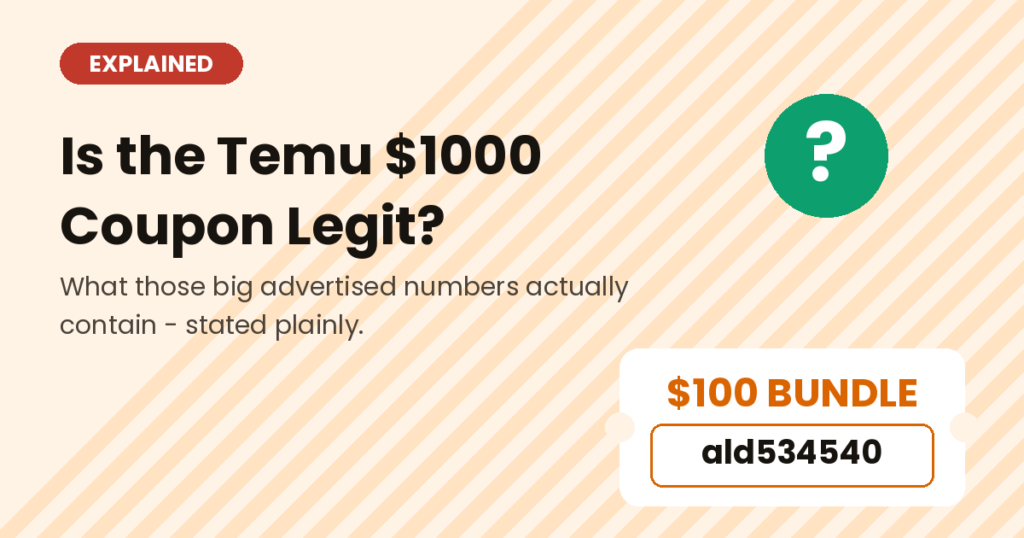
ald534540 — the bundle we list. Advertised at $100, not $1,000, because that’s closer to what the coupons inside actually total.
How to get real value out of a bundle
- Open your coupon list immediately after activating. Note every minimum and every expiry. This takes two minutes and determines whether the bundle is worth anything to you at all.
- Sort by expiry, not by value. The $40 coupon expiring in six days matters more than the $60 one expiring in three months.
- Consolidate orders. Bundles punish frequent small carts and reward occasional larger ones. If you were going to place three $30 orders, one $90 order will trigger coupons the others never would.
- Don’t inflate a cart to chase a coupon. Spending $80 more to save $40 is a loss dressed as a win. This is the failure mode bundles are designed around.
The related question: are the codes themselves real?
Separate issue, and covered properly in our guide to spotting fake Temu codes — the short version being that plenty of coupon sites publish codes that have never worked, and there’s a ten-second test for telling them apart.
For the mechanics of how these coupons interact with each other and with free shipping thresholds, see how Temu coupons actually work.
Disclosure: we may earn a commission when you use our codes or links, at no extra cost to you. Bundle contents, minimums and expiry dates are set by Temu and vary by account and region.